


 En
En English
 Français
 Español
Quality Standards for Fabric Bar Chair Manufacturing: A Complete Guide
Posted by Admin | 16 Sep
Content
A fabric bar chair that fails a weld within six months, or whose upholstery pills after the first season, is not a price problem — it is a specification problem. For B2B buyers, importers, and contract furniture projects, the quality standards for fabric bar chair manufacturing determine whether a low unit cost becomes an expensive replacement cost.
Frame Construction Sets the Lifespan Ceiling
Frame construction is the single largest determinant of a fabric bar chair's useful life, and the easiest place for a manufacturer to cut corners. The frame carries every kilogram of user weight, every swivel, and every shift in posture, so its material and joints must be specified in writing, not assumed from photos.
For commercial use, specify cold-rolled steel tubing with a wall thickness of at least 1.5 mm — and 2.0 mm for cantilever bases that flex under load. Joints should be fully welded and ground smooth; spot-welded or glued joints fail first in real use. A 1.2 mm frame may feel stable during a 20-second showroom sit test and deform within weeks in a busy cafe.
- Four-leg designs need a full-width foot rail or crossbar welded low on the legs to prevent splaying.
- Metal leg ends must carry glides or anti-scratch floor pads; a missing glide is a warranty claim waiting to happen.
- The foot ring on a bar chair must support repeated standing loads, not just a resting foot.
Key frame verification: a static load of 150 kg applied to the seat for 10 minutes, with no permanent deformation, weld cracking, or loosening at any joint.
Fabric Standards Decide Appearance and Wear
Fabric quality is measured by abrasion resistance, seam strength, pilling behavior, and colorfastness — not by how the material feels in a showroom. The Martindale test is the global benchmark for woven fabric wear, expressed in rubbing cycles before the fabric shows thread breakage.
Residential fabric bar chairs should hold at least 20,000 Martindale rubs; contract and hospitality seating should start at 30,000 rubs, with 40,000 preferred for high-turnover bars, restaurants, and hotel lounges. Pilling grade should be 4 or better on the 1-to-5 scale, and seam slippage should stay below 3 mm under a 200 N load.
Typical Martindale ranges for fabric bar chair upholstery; contract seating should specify 30,000 rubs or higher.
Fabric choice also affects maintenance. Velvet reads premium but flattens in heavy traffic, while upholstered boucle fabric bar stools mask wear well and are easy to clean. Chenille needs a high-twist yarn to stay pill-free, and all covers should demand lightfastness of grade 4 and dry-rubbing colorfastness of grade 4 or 5.
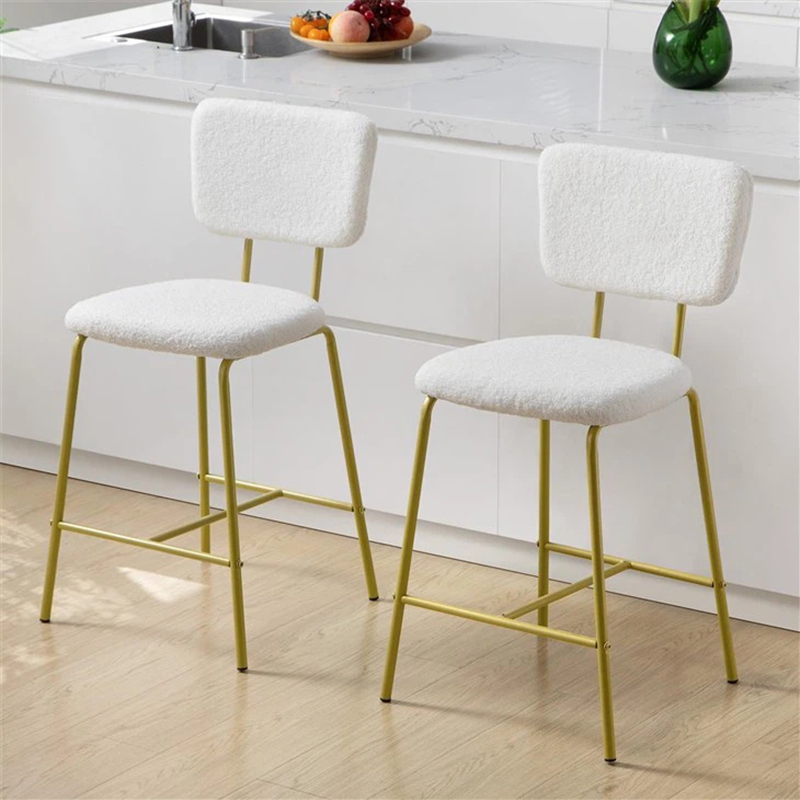 Custom Modern White Upholstered Boucle Fabric Bar Stool Suppliers, ManufacturersAnji Duomei Intelligent Furniture Technology Co., Ltd is China Custom OEM/ODM Modern White Upholstered Boucle Fabric Bar Stool Suppliers ...View Product →
For more detail on interpreting abrasion numbers, see this guide to Martindale ratings for commercial bar stools.
Foam and Seat Cushion Standards
Seat longevity comes from foam density and recovery, not from the thickness of the cover fabric. A beautiful cover over low-density foam produces a chair that sags, bottoms out, and loses its profile within a year.
Specify foam density of 28–35 kg per cubic meter for standard seating, and 35–45 kg for high-use contract seating. High-resilience foam with a 35% indentation force deflection around 120–180 N recovers quickly and holds its shape. The seat cushion should be at least 60 mm thick, with a plywood or steel base plate under the foam so the user sits on the cushion rather than on the frame.
- Reject bonded foam — recycled scraps glued together — which delaminates under load.
- Backrest foam runs lighter at 20–28 kg per cubic meter for comfort, while the seat carries the density requirement.
- Ask for the sag test result: a seat that loses more than 10% of its original height after cyclic loading fails the contract test.
Mechanisms and Hardware: The Wear-Out Zone
Gas lifts, swivel mechanisms, and casters fail long before frames do, and their cycle ratings are the real measure of service life. The height-adjustment and rotation features of a bar chair are exactly what break first in bars and restaurants, so each component needs its own test specification.
| Component | Test Reference | Contract Specification |
| Gas lift | EN 1335 / BIFMA X5.1 | 80,000–100,000 cycle test, 50–75 cm seat range |
| Swivel mechanism | BIFMA X5.1 rotation | 50,000 rotation cycles with no wobble above 2 mm |
| Casters | BIFMA X5.1 rolling | Polyurethane wheels, 50,000 m rolling with no wear-through |
| Foot ring | Cyclic load test | 20,000 downward load cycles without deformation |
Manufacturers such as Anji Duomei Intelligent Furniture Technology Co., Ltd. produce swivel fabric bar stools with height adjustment that pair these components with welded steel bases — which is why component-level test reports matter more than the finished product photo.
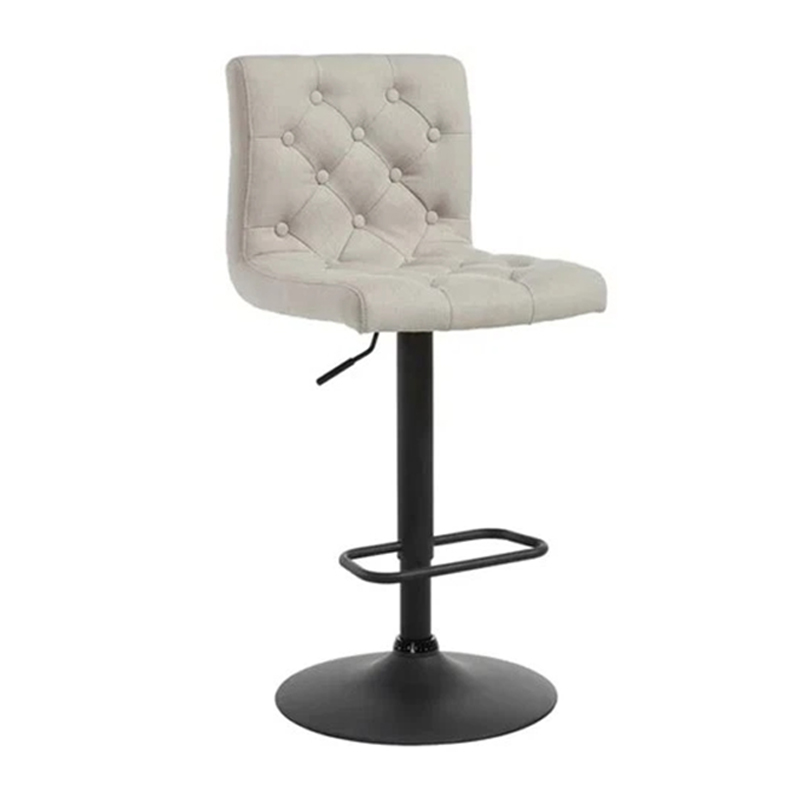 Custom Adjustable Linen Upholstered Swivel Bar Stool with Tufted Back & Metal PeAnji Duomei Intelligent Furniture Technology Co., Ltd is China Custom OEM/ODM Adjustable Linen Upholstered Swivel Bar Stool with Tufted B...View Product →
Stability, Safety, and Certification Standards
A bar chair must pass stability and edge-loading tests before it ships for commercial installation, and the test certificates are what prove compliance with quality standards for fabric bar chair manufacturing. Without them, a chair can be rejected at customs, fail a project audit, or create liability on site.
Residential Grade
EN 12520 or BIFMA X5.4 baseline, 100 kg static seat load, 10,000 seat cycles, 20,000 Martindale fabric, stability checked with a horizontal push at 60 kg.
Commercial / Contract Grade
EN 16139 or BIFMA X5.4 with higher duty, 130 kg static load, 30,000 seat cycles, 30,000+ Martindale fabric, edge-load tests on front and sides, stricter wobble limits.
Flammability is a separate layer: cigarette and match tests such as EN 1021-1/2, or California TB 117 for North American projects. When a supplier offers fabric bar chairs for hospitality, the cover material must also withstand the cleaning agents used in bars and kitchens. Fabric selection and maintenance go hand in hand — see this overview of durable textiles for fabric-covered bar stools.
Factory Audit and Sample Verification
The most reliable confirmation of quality is a staged audit, not a single sample photo. A factory that controls input materials, welding, sewing, and final inspection is the only realistic source of repeatable quality in fabric bar chair production.
Document review
Request ISO 9001, BSCI or an equivalent social audit, material declarations for fabric and foam, and the testing reports listed above.
Production line visit
Inspect the welding station for full penetration, the foam cutter for density consistency, and the sewing line for seam allowance and thread quality.
Pre-shipment inspection
Use AQL sampling with 1.0 critical, 2.5 major, and 4.0 minor limits; verify dimensions, swivel smoothness, height adjustment, and cover finish on random units.
Post-delivery tracking
Keep a reserved sample per batch, log defect claims, and confirm the supplier holds spare parts such as gas lifts and casters for replacement.
Anji Duomei, a contract furniture manufacturer in Anji — the Chinese city known as the country's swivel chair capital — has produced export fabric bar chairs since 2014, and its fabric bar chair collection reflects a matrix of fabric, function, and frame options that buyers can compare against these standards. When evaluating a specific model, start with its ergonomic fabric bar stool with backrest, then request the component and material test reports before ordering.
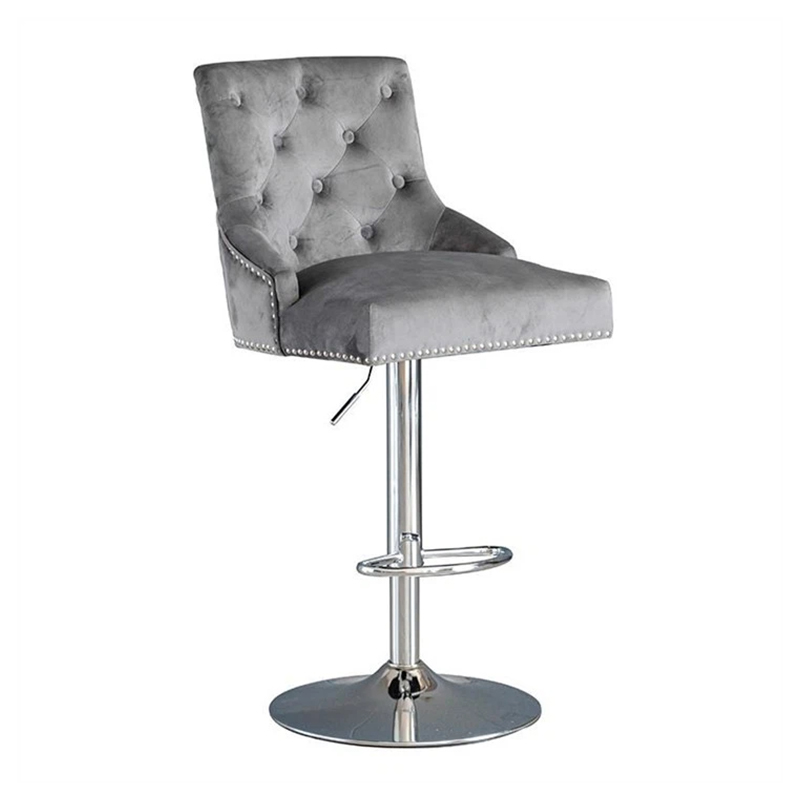 Custom Ergonomically Designed Bar Stool With Backrest Suppliers, ManufacturersAnji Duomei Intelligent Furniture Technology Co., Ltd is China Custom OEM/ODM Ergonomically Designed Bar Stool With Backrest Suppliers an...View Product →
Frequently Asked Questions
What is the most important quality standard for a fabric bar chair?
The frame specification comes first: steel tubing of at least 1.5 mm wall thickness, fully welded joints, and a 150 kg static load test without permanent deformation. A weak frame makes every other quality feature irrelevant.
What Martindale rating should a commercial fabric bar stool have?
A commercial bar stool should carry at least 30,000 Martindale rubs; hospitality projects with constant use should target 40,000 rubs or more. Below 20,000 rubs, the fabric belongs in residential seating only.
How can a buyer verify a factory's quality claims?
Ask for third-party test reports for the frame, foam, fabric, gas lift, and swivel; run a pre-shipment inspection with AQL sampling; and audit the production line at least once before the first order.
Which frame material lasts longer for bar chairs: metal or wood?
Welded cold-rolled steel with a minimum 1.5 mm wall thickness outlasts wood in commercial bar chair use because it resists torsion, moisture, and impact better, especially when the design includes a foot rail and cross bracing.
Related Products
-
 Yangguang Industrial Park 2, Anji County, Huzhou City, Zhejiang Province, China
-
 [email protected]
[email protected]
[email protected]
[email protected] -
 +86-13567991394
QR CODE

