


 En
En English
 Français
 Español
Saddle Stool Design & Load-Bearing Requirements: A Complete Procurement Guide
Posted by Admin | 16 Oct
Content
A dental hygienist leans forward to reach a patient's upper molars, and the flat operator stool beneath her slides backward. By the end of the second appointment, her pelvis has rolled under, her lumbar spine has flattened, and she starts reaching for a lumbar roll. This is the exact failure mode saddle stools were designed to correct in clinics, salons, and medical offices.
This guide covers the two engineering specifications that determine whether a saddle stool will perform: the seat geometry that positions the pelvis correctly, and the load-bearing system that keeps that geometry dependable through years of daily use. Contract furniture buyers evaluating suppliers such as Anji Duomei Intelligent Furniture Technology Co., Ltd., a manufacturer in Anji, China, will find the dimension language and capacity numbers below match what appears on professional product documentation.
Two numbers determine whether a saddle stool works over a five-year contract life: seat width relative to pelvic width, and the load rating of the entire support column, not just the upholstery.
Key Seat Design Parameters of a Saddle Stool
A saddle seat is dimensioned from the user's pelvic width, and the finished geometry must open the hips to 110 to 135 degrees to preserve the natural curve of the lower spine.
Flat seats allow the pelvis to rotate backward, which flattens the lumbar spine and forces the back muscles to recruit continuously. The saddle profile changes that sequence: the raised front and centre profile separate the thighs, lift the pelvis into a neutral anterior tilt, and keep the spine upright without sustained muscle effort. Seat width must match the seated user's pelvic width, not thigh width, because the weight rests on the ischial tuberosities. An oversized seat presses into the inner thighs; an undersized seat concentrates pressure on the ischia and becomes painful within about two hours.
DefinitionSaddle seating is a seat geometry that raises the front of the seat above the level of the pelvis base, separating the thighs and rotating the pelvis forward into a neutral spinal position without requiring a backrest.
Split saddle designs divide the seat into two independent pads with a central gap, which reduces perineal pressure and improves airflow. Single-piece saddles provide a broader, more stable platform for users who shift weight frequently. Neither version is categorically superior; the clinical decision depends on the duration of static sitting and the user's sensitivity to localised pressure.
Load-Bearing Requirements That Define Durability
Load-bearing capacity is set by four structural components: the gas lift class, the base diameter and material, the caster specification, and the reinforced seat plate.
Contract buyers should never rely on a single weight figure in a spec sheet. That number only holds if every component is rated at the same level. A Class 2 gas lift rated for 100 kg fails prematurely in a practice where clinicians lean forward repeatedly during procedures. The correct specification for medical and salon environments is a Class 3 lift for general duties and a Class 4 lift for heavy or multi-user workloads, paired with a five-star metal base and dual-wheel casters matched to the floor type.
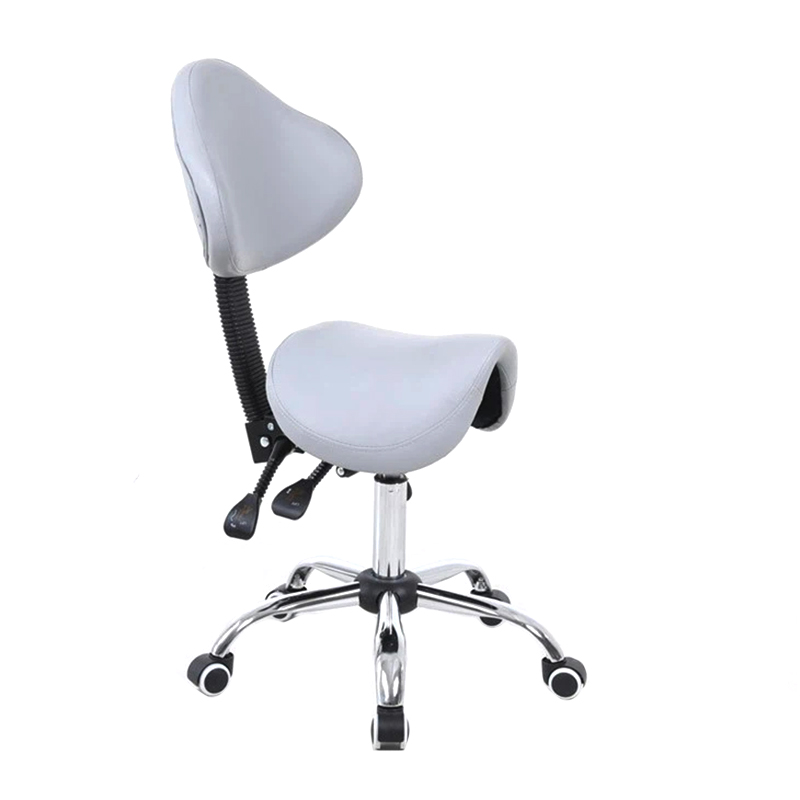 Ergonomic Adjustable Saddle Stool with BackrestThis ergonomic saddle stool with backrest offers adjustable height and a contoured seat. With three leg finishes, it suits salon and medical settings, where structural certification and lift durability matter.View Product →
- Gas lift class: Class 3 supports about 120 kg; Class 4 supports about 150 kg
- Base system: five-star aluminum base, 480 to 560 mm diameter, with a foot ring
- Casters: dual-wheel polyurethane, 50 mm, with locking option for hard floors
- Seat plate: reinforced steel with welded mounting points, minimum 3 mm
A Class 4 gas lift, a five-star base, and dual-wheel casters form the minimum load-bearing package for a saddle stool used more than six hours daily in a clinical role.
Structural certification provides the evidence behind those numbers. BIFMA X5.1 and EN 1335 test seating through repeated loading cycles that simulate years of use; a stool that passes either standard carries verifiable proof of endurance. For purchasers importing seating between regions, documented certification also reduces customs and liability risk. See our summary of structural certification requirements for imported seating before finalising a supplier contract.
| Component | Budget grade | Contract grade |
| Gas lift | Class 2, 100 kg | Class 4, 150 kg |
| Base | Four-star nylon | Five-star aluminum |
| Casters | Single wheel, 38 mm | Dual wheel, 50 mm PU |
| Seat plate | Stamped steel, 2 mm | Reinforced steel, 3 mm |
| Test standard | Reference values only | BIFMA X5.1 or EN 1335 |
Static Load Capacity Across Seating Types
Class 4 saddle stools exceed most operator chairs and fixed stools in static load capacity because the pneumatic column, base, and seat plate are specified together for continuous clinical use.
Static load is the weight a stool can support at rest. Dynamic load, which is lower, describes the forces applied while leaning, reaching, lifting, and rolling. The chart below compares maximum static load ratings for three common seating types.
Specify the static load rating for the heaviest anticipated user plus a 30 percent safety margin. For a practice with 120 kg users, the stool must be rated to at least 150 kg.
Material Selection: Hygiene, Abrasion, and Foam Density
For clinical and salon environments, PU leather is the default cover material because it survives repeated disinfectant wiping and exceeds 100,000 Martindale abrasion cycles without surface breakdown.
Cover material is the first barrier against biological contamination and the most visible wear point on a saddle stool. Medical-grade PU leather resists hydroalcoholic disinfectants, does not absorb fluids, and cleans in one wipe. Textile covers are more breathable and softer against the skin, but they absorb moisture, trap odours, and require more aggressive maintenance. Abrasion resistance is measured in Martindale cycles; contract upholstery should score at least 50,000 cycles, and 100,000 cycles is preferable for seats that are cleaned daily and never rotated. The commercial fabric Martindale rating guide explains how to interpret these figures in a supply contract.
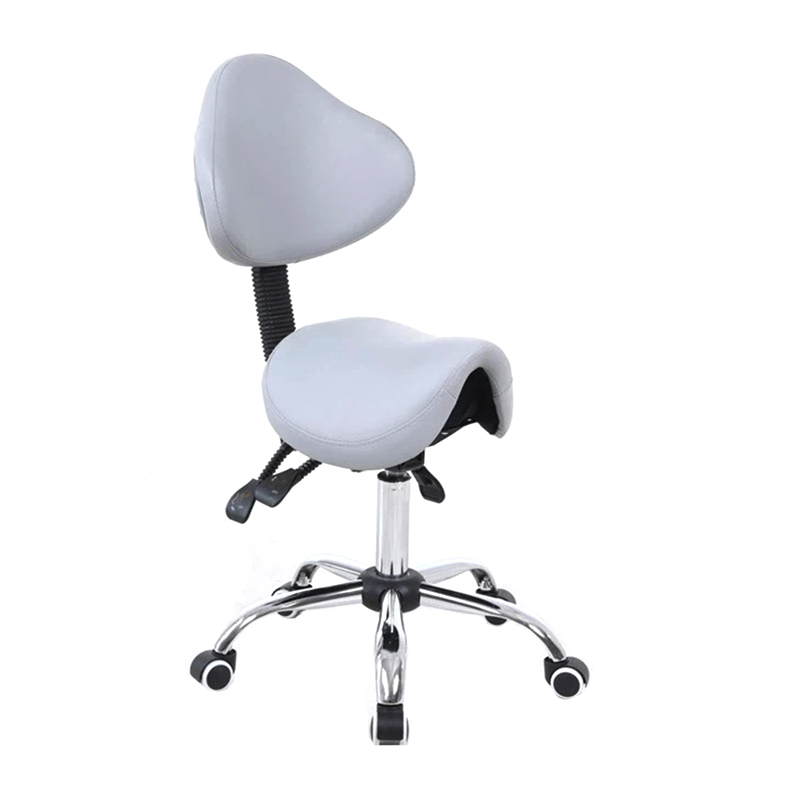 Leather Saddle Stool with Backrest for Dental and SalonThis leather-look saddle stool features a backrest and wipe-clean faux leather cover, suitable for dental and salon use. Optional leg finishes match various decors, while the material resists disinfectants for easier hygiene maintenance.View Product →
PU leather
- Wipeable and alcohol-resistant
- 100,000+ Martindale cycles
- Low moisture absorption
- Easier to disinfect between patients
Textile fabric
- Breathable and soft to the touch
- 40,000 to 60,000 Martindale cycles
- Absorbs fluids and odours
- Requires removable, launderable covers
Foam density sits under the cover and determines whether comfort lasts. High-resilience foam at 35 to 45 kg per cubic metre recovers its shape after each shift; lower-density foam collapses within months, the cover wrinkles, and the pelvic bones start carrying loads the foam should absorb.
A contract specification should state the cover Martindale cycles, foam density, and disinfectant resistance in writing. Verbal assurances disappear after shipment; test certificates do not.
Matching the Configuration to the Workflow
The right saddle stool configuration depends on how long the user holds one posture and how often they pivot between work surfaces.
Dental and medical clinicians lean over patients for sustained periods, so they need a backrest, a lift with at least 15 cm of travel, and locking casters to stop drift. Barbers and hairstylists move around the chair continuously; a 360-degree swivel, hydraulic adjustment, and moisture-resistant PU cover are the priorities. Estheticians and massage therapists sit at the head of the table; a backless design with a compact footprint leaves room to lean over the client without a frame interfering.
- Dental and medical: backrest, locking casters, Class 4 lift
- Salon and barber: 360-degree swivel, hydraulic lift, PU cover
- Esthetician and massage: backless, compact base, wide height range
- Spa and pedicure: anti-rust base, quiet dual-wheel casters
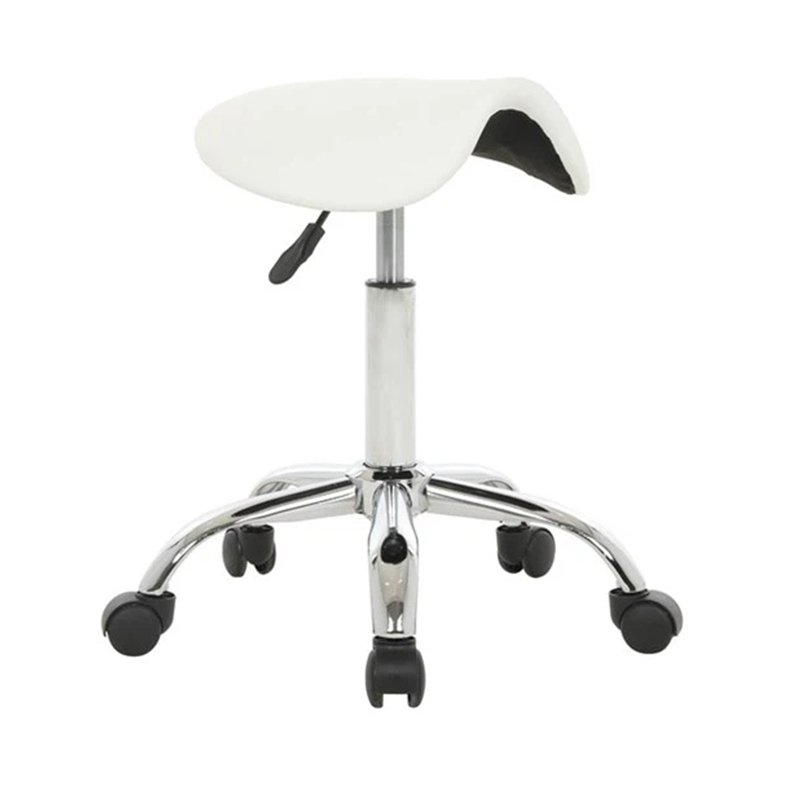 White Saddle Stool Ergonomic Rolling Esthetician SeatThis backless rolling saddle stool offers height adjustment and smooth mobility for estheticians and caregivers. Its compact footprint and swivel base enable easy positioning around clients, supporting the ergonomic needs of beauty and massage work.View Product →
A backrest does not make a saddle stool safer. It only provides extra support for leaning tasks; the seat geometry does the ergonomic work. Select the backrest when the workflow demands forward-leaning stability.
Frequently Asked Questions
How much weight can a saddle stool safely support?
A contract-grade saddle stool with a Class 4 gas lift supports up to 150 kg of static load. Verify that the base, casters, and seat plate are specified at the same level; a strong lift on a nylon base remains structurally weak.
How do I measure the correct seat width?
Measure the pelvic width of the widest regular user in a seated position, then choose a saddle seat that matches within 1 to 2 cm. Oversizing causes inner-thigh friction; undersizing concentrates pressure on the ischial tuberosities.
What is the difference between a split and a single saddle?
A split saddle separates the seat into two pads with a central gap, which relieves perineal pressure and improves airflow. A single saddle provides a broader, more stable platform. Both maintain the 110 to 135 degree hip angle when the geometry is correct.
Can saddle stools roll safely on hard floors?
Yes, when fitted with dual-wheel polyurethane casters rated for hard floors. Braked casters are recommended for dentistry and other precision work where drift during a procedure disrupts the clinician's posture.
Before payment, confirm the gas lift class, base diameter and material, caster type, cover Martindale cycles, foam density, and the specific test certificates the supplier can provide.
Related Products
-
 Yangguang Industrial Park 2, Anji County, Huzhou City, Zhejiang Province, China
-
 [email protected]
[email protected]
[email protected]
[email protected]
[email protected]
[email protected]
-
 +86-18357268872
QR CODE

