


 En
En English
 Français
 Español
Custom Upholstered Chairs: Key OEM Specifications for Furniture Projects
Posted by Admin | 14 Sep
Content
- 1 Why Written Specifications Protect Every OEM Seating Project
- 2 Frame Construction: The Hidden Half of Chair Quality
- 3 Foam Density and Hardness: Specify Numbers, Not Adjectives
- 4 Upholstery Fabric and Abrasion Testing Standards
- 5 Critical Dimensions for Each Seating Application
- 6 Hardware, Finishes, and Compliance Requirements
- 7 Building the Final OEM Specification Sheet
- 8 Frequently Asked Questions
A hotel procurement manager needs 240 upholstered dining chairs for a property opening in 14 weeks. The sample passes the visual check, but the specification sheet lists only "top-grade material" and "high-density foam" without a single measurable value. That gap turns a five-year chair into an eighteen-month failure. Custom upholstered chairs in OEM furniture projects are governed by specifications, not samples, and Anji Duomei Intelligent Furniture Technology Co., Ltd., a contract seating manufacturer in Anji, Zhejiang, sees incomplete spec sheets on almost every project that starts with a drawing but no numbers.
Why Written Specifications Protect Every OEM Seating Project
A written specification is the only contract document that survives sample approval; samples show appearance while specifications define performance.
An OEM chair specification is a formal document that defines materials, dimensions, construction methods, and performance thresholds for a manufactured seating product. In a custom upholstered chair program, it is the difference between a factory quoting with confidence and a factory guessing at every decision point.
Every custom upholstered chair project should lock these parameters before sampling:
- Frame species and moisture content, with kiln-dried hardwood specified by name
- Foam density in kg/m3 and hardness in ILD, never as "high density"
- Fabric abrasion rating in Martindale or Wyzenbeek cycles
- Joint construction method, including dowels, screws, and corner blocks
- Finished dimensions with tolerances of 3 mm on critical seating values
- Static and impact load tests, typically 136 kg static and 90 kg impact for contract seating
When the OEM factory receives a complete specification, engineering can quote accurately and build a sample that passes first-time validation. When the specification is vague, the factory interprets, the buyer assumes, and the difference arrives in a forty-foot container.
Frame Construction: The Hidden Half of Chair Quality
Frame quality determines the service life of an upholstered chair more than any visible material, because a failed frame ends the chair's life no matter how well the fabric and foam have held up.
For contract seating, specify kiln-dried hardwood such as beech or birch with moisture content between 8% and 12%. Kiln drying removes internal resin and reduces warping, and the 8% to 12% range is the international benchmark for stable furniture frames. Engineered wood and multilayer plywood are acceptable for curved back frames, but every joint area still needs reinforcement: corner blocks plus screws, not staples alone.
Joinery Requirements That Prevent Field Failures
The two joinery methods that matter are doweled joints and corner-blocked joints. A doweled joint uses hardwood dowels with wood glue; a corner block adds a triangular reinforcement plate screwed into both frame members. Both outperform butt joints fixed only by staples, which remains the most common frame failure found in imported contract chairs.
The Anji Duomei factory runs a full production line, covering tube bending, punching, stamping, automatic welding, sewing, and assembly, so a single OEM program can mix hardwood frames, metal frames, and hybrid structures. The specification must still state the frame material, the joint method, and the required load test result in writing.
Foam Density and Hardness: Specify Numbers, Not Adjectives
Seat foam density must be written in kilograms per cubic meter or pounds per cubic foot, never as "high density," because that phrase carries no measurable meaning for a factory.
Foam density is the mass of foam per unit volume and indicates how much polymer material sits inside the foam structure; it is the best predictor of sag resistance over time. Hardness is measured separately as ILD, indentation load deflection: 35 to 50 ILD suits seat cushions, while 20 to 35 ILD works for backs and arms. Density controls durability, ILD controls feel, and both must appear on the same line of the spec sheet.
For a contract seat cushion, write a minimum of 2.5 lb/ft3 (40 kg/m3) density, an ILD of 40 to 50, and a cushion thickness of at least 90 mm for dining and lounge applications. For healthcare seating or extended sitting sessions, raise the minimum to 3.0 lb/ft3 (48 kg/m3).
The pair that prevents sagging complaints: density, written as kg/m3 or lb/ft3, and ILD, written as a number. A cushion with 40 kg/m3 density and 45 ILD behaves completely differently from one with 28 kg/m3 and 60 ILD.
Upholstery Fabric and Abrasion Testing Standards
Abrasion resistance is the most frequently misquoted specification in custom upholstered chair projects, because consumer fabric labels and contract test reports measure different realities.
The Martindale test rubs fabric in a multidirectional motion and records cycles until visible wear; the Wyzenbeek test drags an abrasive fabric across the upholstery in one direction. For any commercial program, mark a minimum of 30,000 Martindale cycles or 15,000 Wyzenbeek double rubs and require the factory to attach a test report, not a claim. The commercial fabric rating guide for bar stools explains why fabric-covered seating needs a different threshold than residential sofas.
Three more tests belong on every upholstery specification:
- Colorfastness to light: minimum grade 4 on the blue wool scale
- Pilling resistance: minimum grade 4 on the 1 to 5 scale
- Seam slippage: maximum 6 mm separation at 180 N load
Hotel restaurants, cafes, and lounge areas should demand 40,000-plus Martindale cycles. Velvet, boucle, and chenille can reach contract grades when woven with synthetic reinforcement, but reject any fabric under 30,000 cycles unless the chair is purely residential.
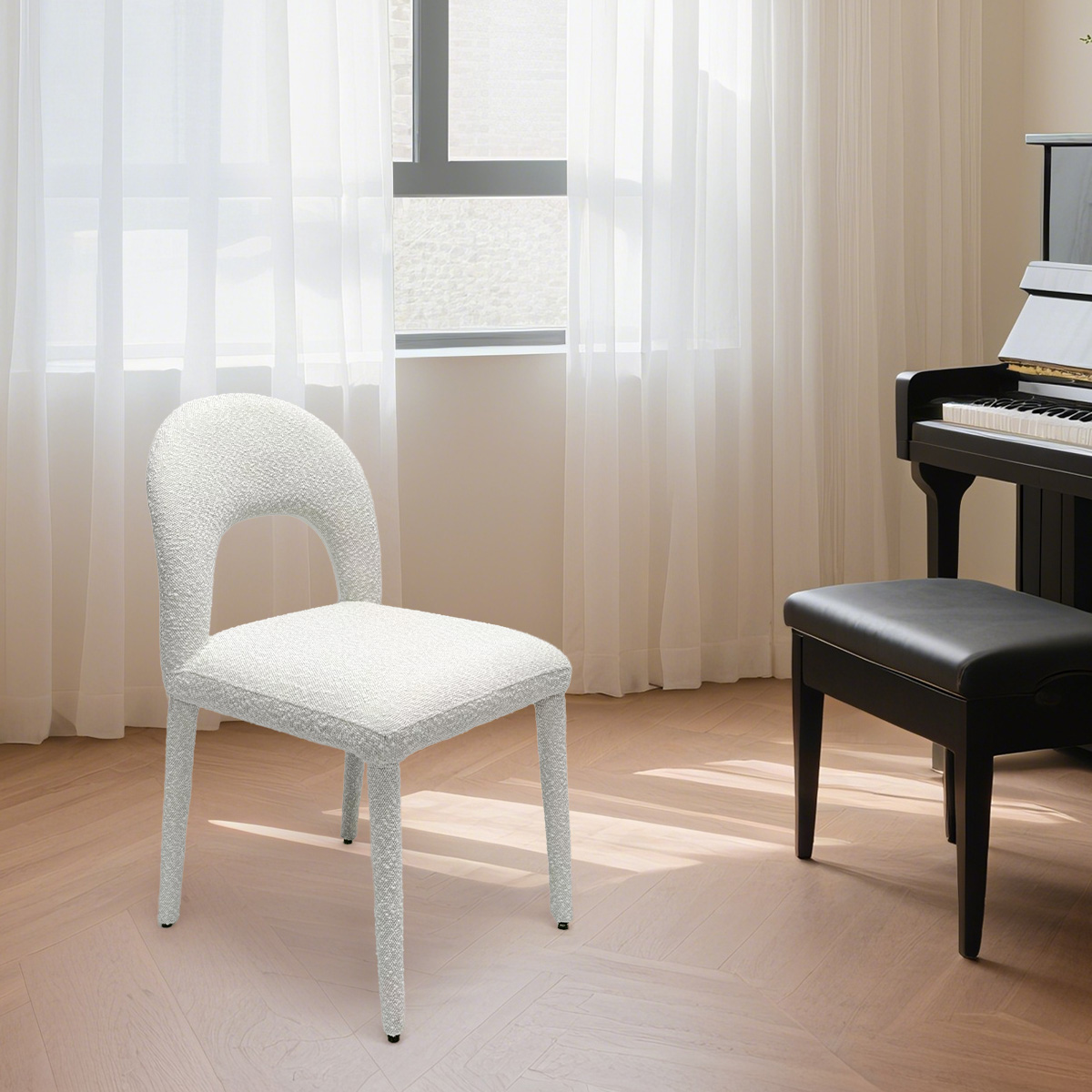 Modern Bouclé Armless Dining Chair with Curved Hollow BackThis upholstered dining chair pairs breathable bouclé fabric with a hollow curved back and extra-wide seat, making it a relevant pick for matching seat dimensions to counter or table heights.View Product →
Critical Dimensions for Each Seating Application
Seat height and seat depth must match the exact counter or table height of the application, because a chair that fits a kitchen island fails ergonomically at a conference table.
| Application | Seat height | Seat depth | Back height | Reference |
| Dining and side chair | 460-480 | 420-460 | 350-450 | Table 720-750 mm |
| Counter stool | 620-660 | 380-420 | 250-350 | Counter 900-960 mm |
| Bar stool | 740-760 | 380-420 | 250-350 | Bar 1000-1060 mm |
| Lounge accent chair | 430-480 | 480-540 | 550-650 | Seat angle 5-8 degrees |
| Home office task chair | 420-530 | 420-480 | 480-550 | Gas lift, adjustable |
For OEM projects, measure finished seat height from the floor to the top of the uncompressed cushion and specify a tolerance of 3 mm. Confirm the gap between armrest and seat so a diner can pull the chair toward the table without the arms jamming against the underside.
Hardware, Finishes, and Compliance Requirements
Every moving part in an upholstered chair, including gas lifts, swivel mechanisms, casters, and footrests, must carry its own cycle-test requirement, separate from the frame and fabric specifications.
- Gas lift: Class 3 or higher, tested to 100,000 cycles for contract use
- Swivel base: 360-degree rotation, tested to 50,000 cycles
- Casters: polyurethane wheels rated for the chair's static load
- Metal finish: powder coating or chrome plating passing a 72-hour neutral salt spray test
Compliance documents must match the destination country: ANSI/BIFMA X5.1 for office seating and X5.4 for lounge seating in North America; EN 12520 and EN 16139 for domestic and contract seating in Europe. Fire resistance follows local rules, from CAL TB 117-2013 in the United States to BS 5852 in the United Kingdom.
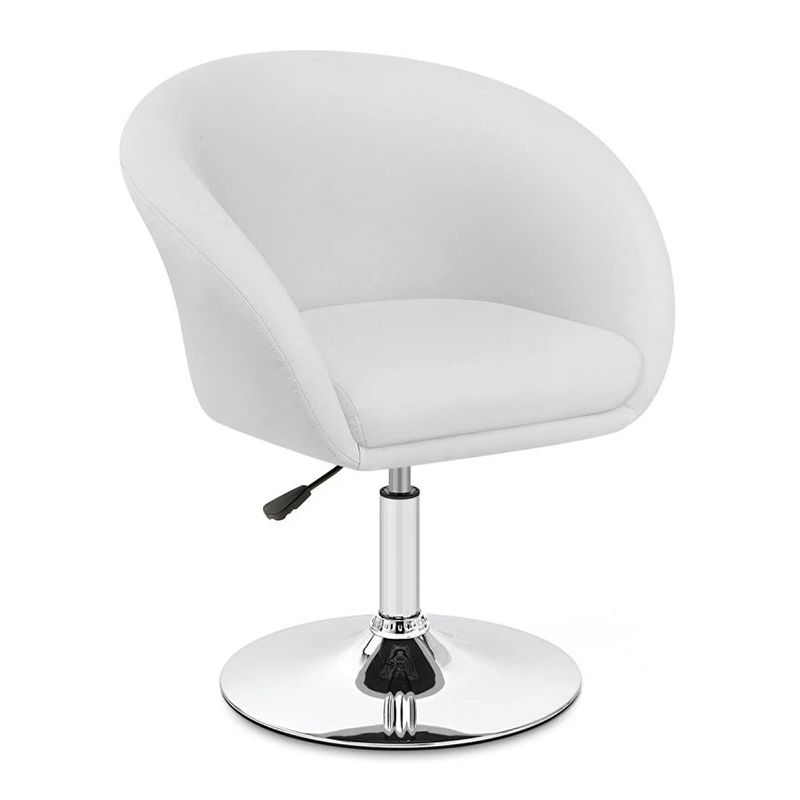 White Upholstered Bar Chair with Hydraulic Lift AdjustmentFeaturing a lever-operated gas lift and PU leather upholstery, this adjustable bar chair suits counter-height social settings and ties into compliance discussions for seating standards.View Product →
Building the Final OEM Specification Sheet
The final specification sheet is the commissioning document for production, quality control, and third-party inspection, so organize it in the same order the factory builds the chair.
- Application and performance class: residential, contract, or heavy-use
- Dimensions with tolerances and a reference drawing
- Frame material, moisture content, and joinery method
- Foam density, ILD, and cushion thickness per surface
- Fabric construction, abrasion rating, and colorfastness
- Hardware specification with cycle-test requirements
- Finish specification with salt spray or coating thickness values
- Compliance standards and required test reports
Send this sheet to the factory with the request for quotation, attach it to the purchase order, and reference it during the pre-shipment inspection. The manufacturer can quote faster, produce consistently, and resolve disputes on the document instead of on a sample that no one can find.
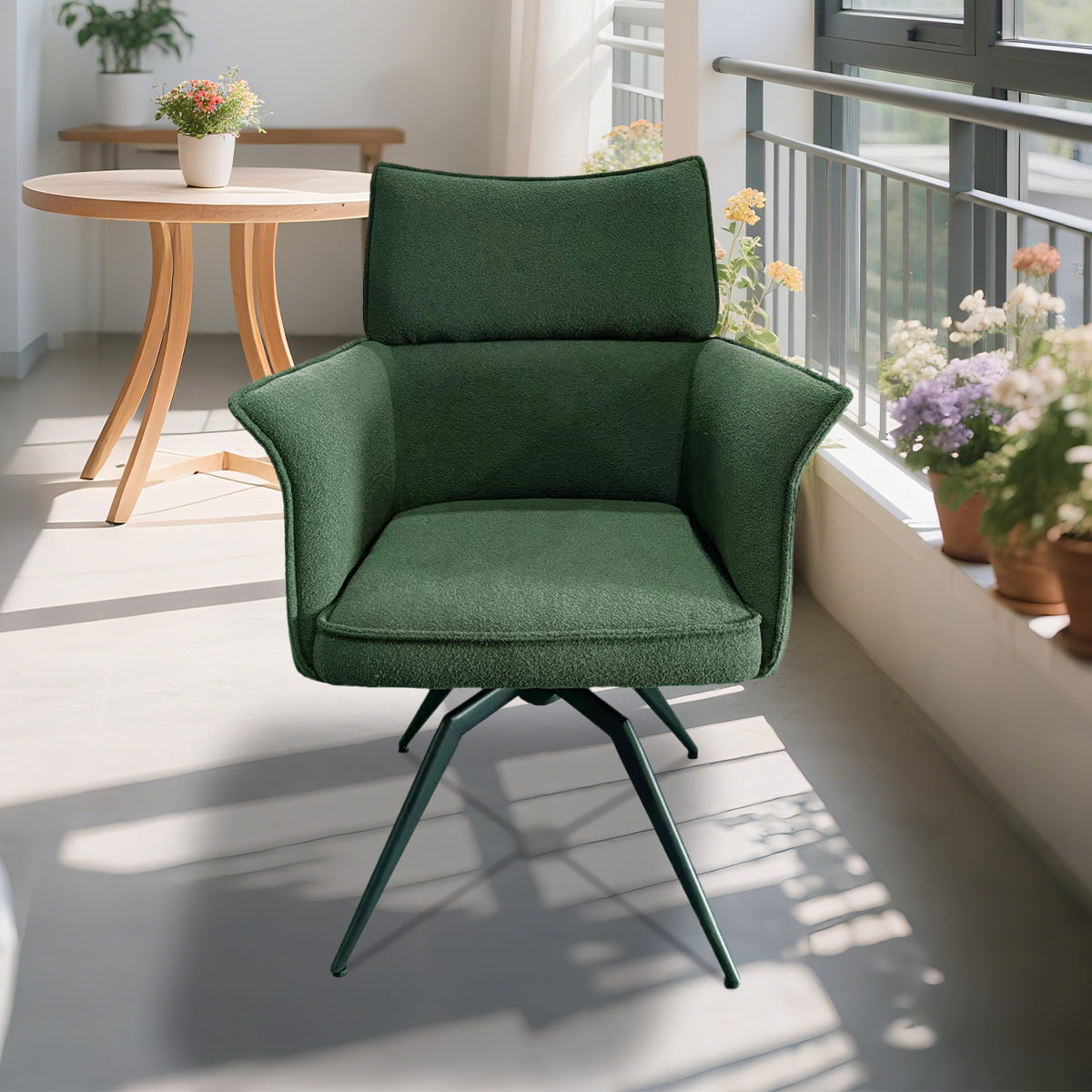 Swivel Lounge Chair with Upholstered Arms and Metal BaseThis 360-degree swivel chair uses bouclé or teddy fleece fabric and high-elastic sponge, offering a stable metal base—useful when specifying cushion density and firmness for contract seating.View Product →
Frequently Asked Questions
What is the minimum foam density for contract upholstered chairs?
Specify a minimum of 2.5 lb/ft3 (40 kg/m3) for contract seat cushions, and raise it to 3.0 lb/ft3 (48 kg/m3) for healthcare or extended-sitting programs. Pair the density with an ILD of 40 to 50 for firm contract support.
What Martindale rating is required for hotel and restaurant chairs?
Use 30,000 Martindale cycles as the absolute minimum for contract fabric, and 40,000 to 50,000 cycles for high-traffic hotel restaurants and banquet seating. Require a test report from an accredited laboratory.
How long does an OEM custom upholstered chair order take?
A catalog model with minor changes typically ships in four to six weeks from sample approval. A fully custom frame with a new fabric and finish usually needs eight to ten weeks, depending on material availability and test requirements.
Related Products
-
 Yangguang Industrial Park 2, Anji County, Huzhou City, Zhejiang Province, China
-
 [email protected]
[email protected]
[email protected]
[email protected] -
 +86-13567991394
QR CODE

