


 En
 English
 Français
 Español

Saddle Stool Manufacturing: Production Processes and Load Testing Factors Explained
Posted by Admin | 25 Nov
Content
- 1 What Defines a Saddle Stool and Which Production Factors Matter
- 2 Load Testing: The Gate That Decides Market Access
- 3 How Saddle Stools Are Manufactured: From Steel Tube to Tested Seat
- 4 Upholstery Materials and Cover Choices That Change Test Results
- 5 Common Failure Points and How Load Testing Catches Them
- 6 Saddle Stool Manufacturing and Load Testing: FAQs
A clinic that orders fifty saddle stools is not buying a chair; it is buying a promise that the seat will hold a 95 kg user, roll smoothly across tiled floors through three daily shifts, and still raise and lower cleanly after 100,000 cycles. Saddle stool manufacturing looks simple from the outside — a contoured seat pan, a gas lift, five casters — but every one of those components is load-bearing. This guide looks at the production decisions and load testing steps that separate a saddle stool that clears export inspection from one that fails six months after installation.
Two documents matter before any order is placed: the production flow chart and the load test protocol. The first shows how the seat is welded, upholstered, and assembled; the second shows what happens when a 2000 N static load lands on the seat and stays there. Both are discussed below from the perspective of a contract furniture manufacturer.
What Defines a Saddle Stool and Which Production Factors Matter
A saddle stool is a height-adjustable, wheeled task seat whose saddle-shaped seat pan tilts the pelvis forward, keeping the lumbar spine in a neutral curve during long seated work.
A saddle stool is a contract-grade task seat with a contoured saddle-shaped pan, a pneumatic height adjustment, and a multi-caster base, designed for professionals who sit for six or more hours per day in clinics, dental practices, salons, and studios.
The production factors that determine structural quality are the seat shell, the metal base, the gas lift, the casters, the welds, the upholstery seam, and the foam density. Each maps directly to a load test outcome:
- Seat shell — injection-molded polypropylene or molded plywood; an overly flexible shell causes the cover to delaminate.
- Steel base — ring or five-star base with a tube wall thickness of 1.5 to 2.0 mm; governs tip-over stability.
- Gas lift class — usually a 150 to 200 mm stroke; the rated cylinder force must match the intended user weight range.
- Weld quality — the column-to-base joint is the most common catastrophic failure point in the entire product.
- Foam density — target densities of 35 to 40 kg/m³ hold the saddle contour through 100,000 cycles.
- Upholstery seam — thread strength and stitch tension determine whether the cover survives repeated seating loads.
Anji Duomei Intelligent Furniture Technology Co., Ltd., a contract furniture manufacturer in Anji, Zhejiang, China, produces saddle stools alongside bar chairs, home office chairs, and salon chairs on a 4,000-square-meter production floor. Its saddle stool range spans backless esthetician seats, massage stools on wheels, and leather models with backrests for dentist clinics — a breadth that only makes sense when the production platform, not just the final model, is tested.
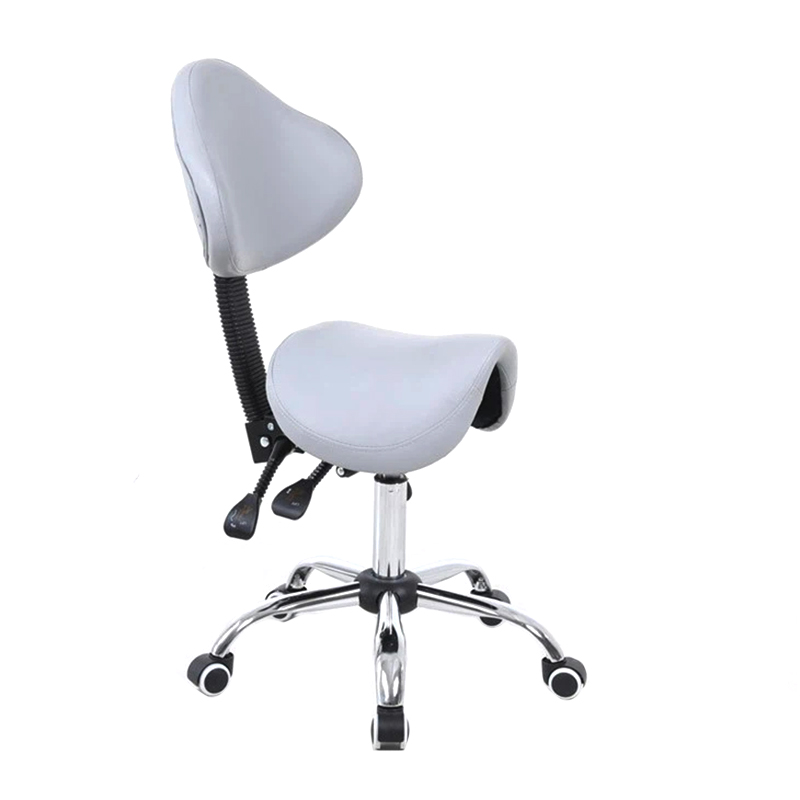 Adjustable Saddle Stool with Backrest for Medical UseThis stool combines an ergonomic saddle seat with a backrest and adjustable height, making it suitable for long work hours in beauty and medical settings. Its leg options and construction merit attention when considering load-bearing durability.View Product →
Load Testing: The Gate That Decides Market Access
Load testing measures a saddle stool's ability to support both repeated and extreme body weight without permanent deformation, weld fracture, or sudden collapse.
Three load test groups matter for saddle stools: static load, dynamic fatigue, and stability. Static load simulates a heavy user sitting down hard or even standing on the seat. Fatigue testing simulates years of sit-stand cycles. Stability testing simulates leaning, reaching, and shifting weight to one side.
Typical contract load test thresholds (newtons)
| Test group | Typical load and method | Acceptance criterion |
| Static seat load | 2000 N applied to the seat area for 10 minutes | No fracture, no permanent deformation over 10 mm |
| Seat fatigue | 100,000 cycles at 1000 N | No weld crack, no gas lift failure, no noise |
| Stability tip-over | 300 N horizontal push at seat height | No leg lifts off the floor |
| Backrest load | 560 N static on the backrest for 5 minutes | No detachment and no permanent flex |
Buyers should treat load test data as a specification item, not a marketing claim. The fastest way to compare suppliers is to ask for the load in newtons, the number of cycles, and the exact standard applied.
How Saddle Stools Are Manufactured: From Steel Tube to Tested Seat
Saddle stool production follows a fixed sequence — tube cutting, bending, welding, surface finishing, shell and foam preparation, upholstery, assembly, and final load verification — and every skip shows up later in the test results.
- Tube cutting and bending. Steel tube is cut to length and bent into the ring or five-star base. Dimensional tolerance is usually held to within 1 mm.
- Welding and grinding. Automated MIG welding joins the column housing to the base; the weld seam is ground flush before coating.
- Surface finishing. Powder coating or chrome plating protects the base. Coating thickness matters in salons that disinfect metal parts daily.
- Seat shell and foam. The polypropylene shell is injection molded, then foam is cut or molded to the saddle contour at a density of 35 to 40 kg/m³.
- Upholstery. PU leather, PVC leather, or fabric is wrapped around the shell and stitched. Seam position on the saddle nose directly affects abrasion test results.
- Assembly and gas lift fitting. The lift, caster stems, footring, and return mechanism are fitted with specified torque values.
- Load verification. A sample from each production batch is loaded and cycled before the batch is palletized for export.
A factory that keeps welding, foam cutting, upholstery, and assembly under one roof can move a batch of saddle stools from raw steel tube to palletized export cartons in days — but only when the load test station is part of the line. When testing is outsourced to a separate laboratory, the feedback loop is too slow and the same defect repeats across multiple batches.
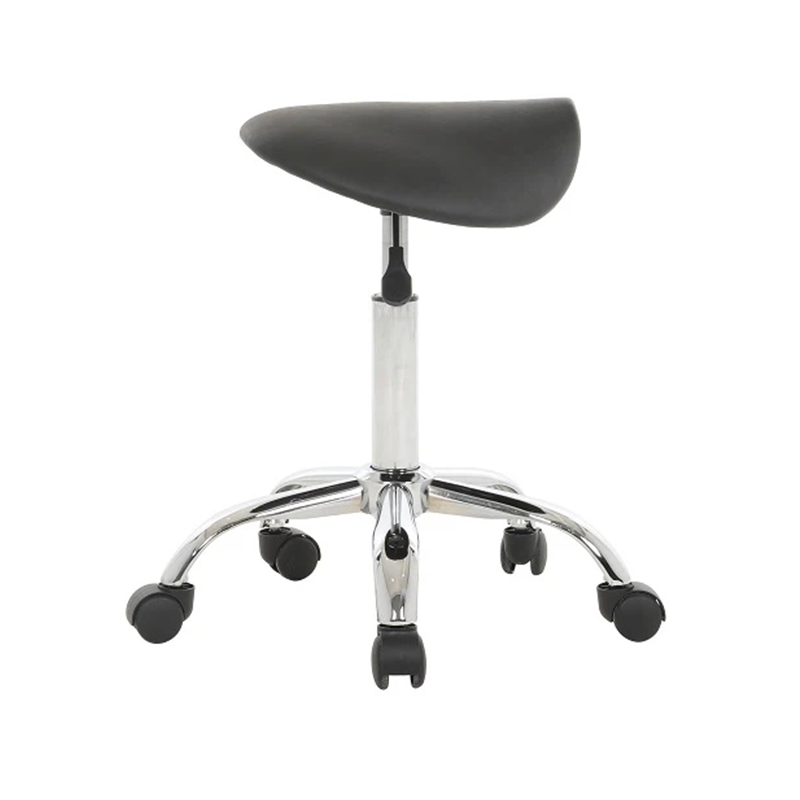 Rolling Massage Saddle Stool with Adjustable HeightWith wheels, a gas lift, and built-in massage nodes, this stool supports mobility and posture. Its PU cover and steel frame are relevant when assessing abrasion and seam strength for frequent use environments.View Product →
Upholstery Materials and Cover Choices That Change Test Results
The upholstery cover is the first part of a saddle stool to wear out, and the choice between PU leather, PVC leather, and fabric determines which abrasion and seam tests the stool can pass.
PU leather
- High abrasion resistance for daily disinfection
- Wipes clean with clinic-grade chemicals
- Risk: surface cracking after years of chemical exposure
PVC leather
- Lower cost and fully waterproof
- Easy to match in a mixed fleet of salon chairs
- Risk: plasticizer migration stiffens the material in cool rooms
Fabric
- Breathable and more comfortable in long shifts
- Must reach 30,000+ rubs on the Martindale scale for contract use
- Risk: staining and seam slippage if thread tension is wrong
Fabric covers change the testing conversation entirely, because the wear mechanism is abrasion rather than chemical resistance. Buyers should ask for the Martindale abrasion thresholds for commercial seating before accepting a fabric-covered saddle stool specification.
For clinics that disinfect seats between every patient, a cover that passes a 30,000-rub abrasion test and a wipe-cleaning chemical test is more valuable than a material data sheet full of untested claims.
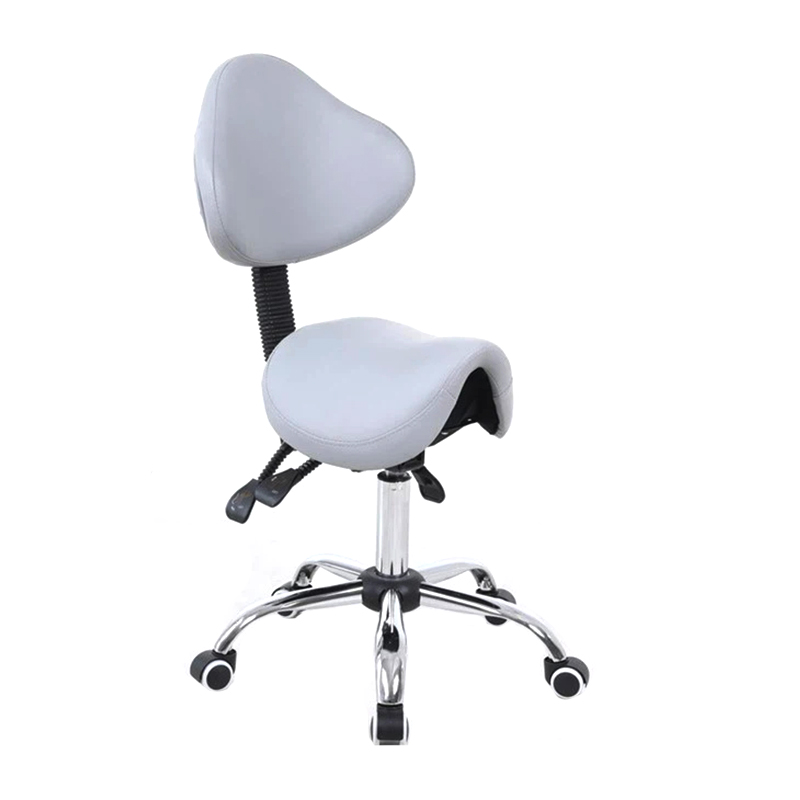 Leather Saddle Stool with Back for Clinics and HomeDesigned for dentist offices and beauty salons, this stool features a saddle seat and backrest with multiple leg finishes. Its material choice and construction are key to withstanding disinfecting routines and everyday wear.View Product →
Common Failure Points and How Load Testing Catches Them
Field failures on saddle stools cluster at five predictable points: the column-to-base weld, the gas lift seal, the caster stem, the saddle seam, and the footring bracket.
| Failure point | Root cause in production | Detected by |
| Column-base weld crack | Low welding current or skipped weld pass | 100,000-cycle seat fatigue test |
| Gas lift slow drop or leak | Undersized cylinder or failed seal | 50,000-cycle lift endurance test |
| Caster stem shear | Thin stem wall or brittle nylon | Static base load plus rolling test |
| Saddle seam tear | Low thread strength or loose tension | Seam pull test plus abrasion test |
| Footring bracket break | Oversized bend radius or thin tube wall | 800 N static footring load |
The pattern behind this list is consistent: roughly two-thirds of field failures in contract seating trace back to production variables — weld quality, assembly torque, thread tension, foam density — rather than to design errors. That is why a factory-level load test is the single most effective control a buyer can specify.
Saddle Stool Manufacturing and Load Testing: FAQs
What load can a commercial saddle stool carry?
A properly manufactured saddle stool should pass a static seat load of at least 2000 N — about 200 kg — without fracture or permanent deformation. In daily use, most manufacturers rate such stools for users up to 120 to 136 kg, which covers the large majority of clinic and salon staff.
How many fatigue cycles should a saddle stool survive?
Contract seating protocols such as EN 16139 and BIFMA X5.1 use 100,000 cycles for durable products. In a busy salon, 100,000 sit-stand cycles is roughly equivalent to five years of continuous operation.
Are backless saddle stools tested differently from models with a backrest?
Yes. Backless saddle stools are tested for seat load, stability, and gas lift function. Models with a backrest add a backrest static load test and a backrest fatigue test, which slightly increases the structural cost.
What should a buyer check in a factory load test report?
Check four items: the load in newtons or kilograms, the number of cycles, the pass-fail criteria, and the standard applied, for example EN 16139 Level 2. A certificate that lists no test parameters is not evidence of testing.
Related Products
-
 Yangguang Industrial Park 2, Anji County, Huzhou City, Zhejiang Province, China
-
 [email protected]
[email protected]
[email protected]
[email protected]
[email protected]
-
 +86-18357268872
QR CODE

