Content
A carton can arrive without a crushed corner and still contain a marked seat, a scratched frame or the wrong hardware. For a furniture importer, each of these problems can make a chair unavailable for sale or delay a customer’s installation.
The useful question before shipment is not simply whether a chair has enough wrapping. It is whether the packed product stays supported, separated and correctly identified through the handling it will face.
The five anonymized cases below come from our customer packaging and loading reviews. They show risks identified and changes made before shipment, together with the checks needed to verify those changes. They do not report measured reductions in transit damage.
Before approving packaging, tell the supplier how the chairs will reach the end customer. A container unloaded at one warehouse may be followed by pallet storage, local truck delivery or individual parcel shipments. Packaging reviewed only for the first leg may not address later handling.
Confirm the chair model, finish, assembly configuration, units per carton and any separate cartons belonging to the same chair. Then record the intended handling method, stacking arrangement and destination distribution route.
For an existing damage problem, provide photos of the product, its position inside the carton, internal supports, carton markings and the outer box. Keep the affected model and batch identifiable. A close-up of a scratch alone may not show what contacted the surface or where movement occurred.
Protective bags can help keep surfaces clean, but they do not stop a hard component from pressing into upholstery. Check the position of detached legs, frame ends and hardware around the seat, backrest and edges. Examine the relationship between parts after handling, not only when the packer first places them in the box.
An importer sourcing light-colored upholstered dining chairs planned to pack two chairs per carton. To reduce packed volume, the detached legs were placed in the same box as the seats.
During the packaging sample review, the buyer found that the bagged legs had no fixed location. When the carton was moved, a leg could shift toward the seat and leave a hard end pressing against the upholstery. The carton did not need to show visible damage for this contact to create a risk of pressure marks or abrasion.
We created a separate fixing area for the legs, added separation between hard parts and fabric, and revised the internal supports to avoid concentrating pressure on the upholstered surface. The revised sample was checked again for component positions and contact points.
What to verify: after the agreed packaging validation, inspect the seat, backrest and edges for indentation, scuffing and staining. Check whether the leg restraints and supports stayed in position. An intact carton alone is not an acceptance criterion for the chair inside.
For coated metal frames, inspect where parts could touch if a restraint loosens or a separator shifts. Frame corners, footrests and connecting areas may need local protection. Adding another loose outer bag does not address movement between the components.
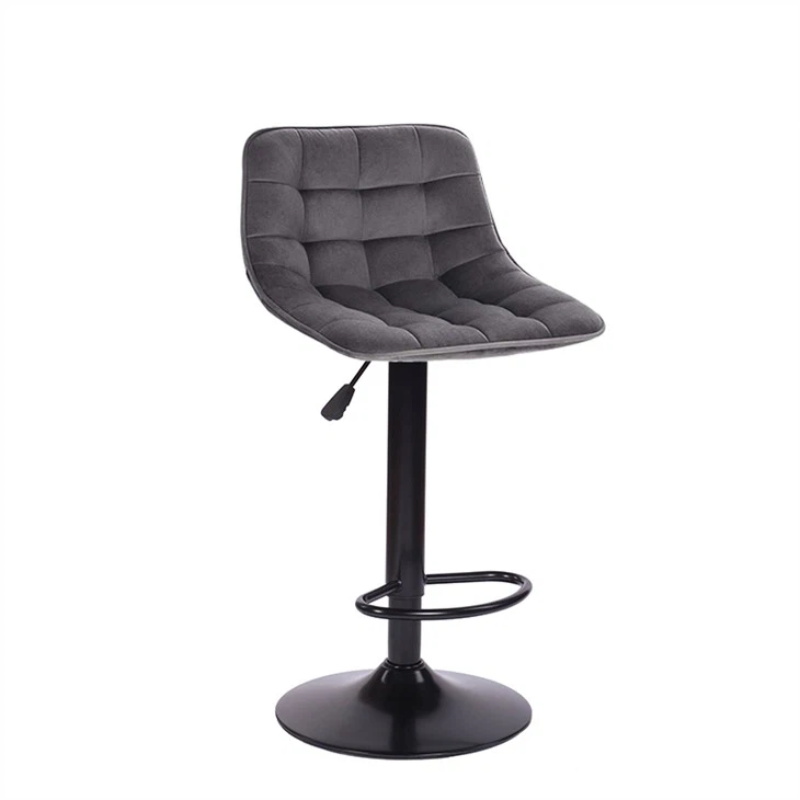
A hospitality furniture buyer ordered black metal bar stools. The dismantled frames and footrests were individually bagged and packed in the same carton.
The sample review showed that two metal components were close together and had room to move inside the box. The bags separated their surfaces initially, but repeated movement could still cause rubbing at the contact points.
We added dividers and restraints shaped to hold the components apart. The footrest connections and frame corners received specific protection rather than relying only on more wrapping around the entire product.
What to verify: examine those contact areas after packaging validation for scratches or coating wear, and check whether the dividers and restraints loosened. The important evidence is whether the components remained separated throughout the agreed test, not simply whether protective bags were present at the start.
Internal support should hold the chair at suitable load-bearing areas and limit movement. Filling visible gaps without checking the load path can leave a projecting leg exposed or transfer force to a small connection.
Packaging checks also need a product baseline. Record the condition of joints, rails and legs before packing so that a pre-existing assembly or structural problem is not automatically attributed to transport.
A furniture retailer sourced partially assembled wooden dining chairs. The original pack included cushioning around the backrest and seat but left space near the ends of the legs.
On inspection, the chair could still move inside the carton, and some projecting areas lacked support. Handling impact could bring those areas into contact with the box and transfer force into the legs or joints.
We rearranged the supports to limit whole-chair movement and added protection around the exposed areas. The support locations were reviewed against the chair’s load-bearing structure to avoid concentrating force on small connectors. The pre-packing connection condition was checked separately.
What to verify: after packaging validation, inspect legs, rails and joints for cracks, looseness or deformation. Examine the cushioning for collapse or displacement. Additional padding is useful only if the product remains supported in the intended way.
A chair that arrives undamaged but cannot be assembled still creates a customer problem. Checking that an accessory bag is present is not enough: its contents must match the model and the current assembly instructions.
An importer purchased two visually similar knock-down dining chair models. Their screw specifications differed, but the accessory bags and outer labels did not clearly distinguish the models.
The review identified a risk that packing staff could insert the wrong bag. A simple visual check for “one hardware bag per carton” would not detect the mismatch.
We labeled the bags with the corresponding model and part quantities, fixed them in a designated position inside each carton, and used model-specific parts lists at the packing station. The product, instructions, hardware bag and carton markings were matched item by item.
What to verify: count and identify the hardware, check the instruction version, and assemble a sampled chair using the actual parts from its carton. Do not substitute a separate workshop hardware set during this check. Trial assembly can reveal a specification mismatch that a bag count misses.
A carton specification should be assessed with the packed weight, support arrangement and intended stacking conditions. Board description alone does not establish how the finished package will behave in the proposed load.
Ask what evidence supports the stated stacking limit: which packed configuration was evaluated, under what conditions, and against what acceptance criteria. Where compression testing is required, agree the method and conditions with the packaging specialist or laboratory. A stated number of layers should not be copied to a different carton or load without review.
The IMO/ILO/UNECE CTU Code provides general guidance on packing and securing cargo transport units. It is a useful reference for the loading review, rather than proof that a particular chair carton or arrangement is adequate.
A wholesaler planned to mix upholstered dining chairs and heavier accent chairs in one container. The cartons had different dimensions. The initial plan used the space above the dining chair cartons for the accent chair cartons.
The review found that the plan accounted for total volume but did not confirm the lower cartons’ load-bearing capability. The different footprints also created a risk of unsupported edges and concentrated pressure.
We revised the arrangement using each model’s gross weight, carton load-bearing capability and permitted stacking layers. Packages unsuitable for upper loads were repositioned. The review also covered carton support, overall weight distribution and the restraint of gaps.
“Put heavy cartons underneath” was only a starting consideration. The bottom packages still needed to carry the load, and the complete stack needed to remain stable.
What to verify: compare the actual load with the agreed arrangement. During loading, check for unsupported cartons, leaning stacks, crushing and unsecured gaps. Keep photographs of the critical positions before they are hidden by later rows.
A sample review is useful for finding contact points and missing restraints. It is not equivalent to a transport test. Handling a box by hand cannot establish how it will respond to the agreed vibration, impact or compression exposure.
Select validation around the actual product and distribution route. ISTA distinguishes procedures for different shipment systems, including parcel delivery, less-than-truckload transport and unitized loads. A procedure should be selected for its scope, not because its name appears in a supplier’s standard quotation.
Before testing, agree the following with the supplier and, where appropriate, the laboratory:
Inspect the product after the required test sequence. A report should identify the package actually tested and describe the result against the agreed criteria. “Drop tested” without the method, sample identity or findings gives a buyer little basis for approval.
ISTA also identifies changes to products and packaging as relevant to retesting decisions. If the carton, internal support, product configuration or closure changes, review whether the existing evidence still applies before using it to approve production.
Keep sample approval, production inspection and loading checks separate. Each answers a different question.
| Approval point | Buyer’s question | Evidence to retain |
|---|---|---|
| Packaging sample | Does this design protect the selected product under the agreed conditions? | Approved packing specification, internal layout photos and applicable validation report |
| Production packing | Are the goods being packed to that approved version? | Inspection records, carton measurements, hardware checks and sampled assembly findings |
| Container loading | Does the actual arrangement respect the package limits? | Loading plan, packing list and photos of support, stacking and securing |
Record product appearance before packing and compare the finished pack with the approved sample. Check the carton count, dimensions, gross weight, internal material positions and markings. Define the sampling approach with the inspection provider according to the order and risks; an unspecified “random check” leaves too much open to interpretation.
If a different carton, restraint or packing sequence appears during production, resolve that difference before accepting it as equivalent. When a test or inspection fails, record the correction and the evidence needed for acceptance rather than relying only on a verbal assurance.
The cheapest package is not necessarily the lowest-cost delivered solution. Compare the added material, labor and packed volume with the repair, replacement, rehandling or delivery disruption the change is intended to prevent. Use your own order and claims records for that comparison.
The cases above identify specific risks and corrective actions. They do not establish a universal damage rate or savings percentage. For an ongoing purchasing program, record affected units by model, packaging version and defect type, together with quantities received and handling conditions. That makes subsequent comparisons more meaningful than pooling all returns into one number.
Planning a new chair order, changing to knock-down packing or investigating damage on arrival? Send Duomei Home your model references or photos, order quantities, assembly preference and delivery route.
If you already have a problem to resolve, include the damaged area, the internal packing arrangement and the carton label in your photos. Tell us whether the chairs will go directly to a warehouse, through retail distribution or onward as individual parcels.
These details provide a starting point to discuss product-specific packing, the evidence needed before approval and quotation requirements. You do not need to design the export carton yourself before making an inquiry.
Yes. Detached parts can move, rub or press against the product without visibly crushing the box. Open sampled cartons and inspect the product and restraints; do not use external appearance as the sole acceptance check.
It may address an identified carton-strength issue, but it will not correct loose hardware, incompatible contact points or unsupported components. Match the correction to the observed failure mechanism.
Neither is automatically safer. Knock-down packing may reduce volume but introduces separate parts and assembly requirements. Assembled packing needs suitable support for the complete structure. Review and validate the selected configuration.
They may share an outer carton specification if their packed dimensions, weights and protection needs are compatible and the configurations are validated. Internal supports and labels may still differ. Similar appearance alone is not sufficient evidence.
Request the approved specification and relevant validation records for the actual product and package. Check sample identity, test method, acceptance criteria, findings and revision status. Generic photographs of another model’s packaging are not equivalent evidence.
Customer cases: anonymized Duomei Home customer packaging and loading review records. External references support the general technical guidance, not the individual customer cases or their outcomes.
Related Products
Yangguang Industrial Park 2, Anji County, Huzhou City, Zhejiang Province, China
[email protected]
+86-18357268872