


 En
 English
 Français
 Español

Barber Chair Dimensions: Key Parameters for Salon Furniture Manufacturing
Posted by Admin | 18 Nov
Content
- 1 The Six Barber Chair Dimensions to Compare First
- 2 Seat Dimensions: Where Client Comfort Meets Workshop Reality
- 3 Height Range, Hydraulic Pumps and the Base Footprint
- 4 Tolerances: Where the Specification Meets the Production Line
- 5 From Floor Plan to Container: Spacing, Packaging and Paperwork
- 6 Frequently Asked Questions
A salon owner in Manchester once ordered eight barber chairs from an overseas catalog, and delivery day turned into a puzzle: the 30-inch bases would not pass through the 34-inch gaps between mirror stations, and two chairs went straight back onto the truck. Cases like that explain why experienced buyers read a dimension sheet as carefully as a price sheet. For a contract seating manufacturer such as Anji Duomei Intelligent Furniture Technology Co., Ltd., which has produced salon and barber chairs for export since 2014, dimensions are the first numbers agreed with an OEM client and the last ones checked before a container is sealed. The sections below set out the parameters that matter, the tolerances behind them, and what they mean for both the salon floor and the shipping plan.
Barber chair dimensions are the measurable specifications that define a chair in production and in use: seat width and depth, adjustable height range, base footprint, recline angle, weight capacity, and the clearance required around each styling station.
The Six Barber Chair Dimensions to Compare First
Seat width, seat depth, height range, base footprint, recline angle and weight capacity are the six parameters that decide whether a barber chair fits a given salon. Each one serves a different stakeholder: seat measurements protect the client and the stylist, height range serves the barber's posture, base and recline figures belong to the installer planning the floor, and weight capacity is the buyer's safety guarantee. Comparing all six side by side, rather than judging a chair by its cover, is what separates a professional purchase from an expensive guess.
| Parameter | Typical Range | Why It Matters In Production |
| Seat width, inside arms | 19-26 in / 48-66 cm | Sets armrest bend and foam mold width |
| Seat depth | 17-21 in / 43-53 cm | Drives foam thickness and front edge radius |
| Seat height range | 19-30 in / 48-76 cm | Pump stroke plus base and frame stack |
| Base footprint | 24-30 in diameter | Casting weight must balance recline loads |
| Recline angle | 30-45 degrees | Mechanism travel and headrest position |
| Weight capacity | 300-450 lb / 136-204 kg | Frame gauge, weld quality and pump rating |
Plan 36 to 42 inches of width per station. A chair with a 26-inch seat and a 30-inch base leaves only 6 to 10 inches of margin in a 42-inch bay once mats and trolleys are in place.
Seat Dimensions: Where Client Comfort Meets Workshop Reality
Seat width, measured inside the armrests, typically runs from 19 to 26 inches on professional chairs, and 22 to 24 inches is the commercial sweet spot. Width beyond that rarely helps: it pushes a broad-shouldered client away from the backrest and forces the stylist to lean across the arms. Depth matters just as much, with 17 to 21 inches the usual band, long enough to support the thighs yet short enough to keep pressure off the back of the knees during long shave services. In the workshop, these numbers drive the foam mold and the armrest bend. High-density foam in the 32 to 45 kg per cubic meter range keeps a seat from bottoming out, and PU or PVC leather covers are specified because they wipe clean between clients.
The target seat is wide enough for a broad-shouldered client yet shallow enough for the stylist to reach the headrest without stretching. In production, that balance usually lands between 22 and 24 inches of inner width.
See how these numbers translate into a finished production model:
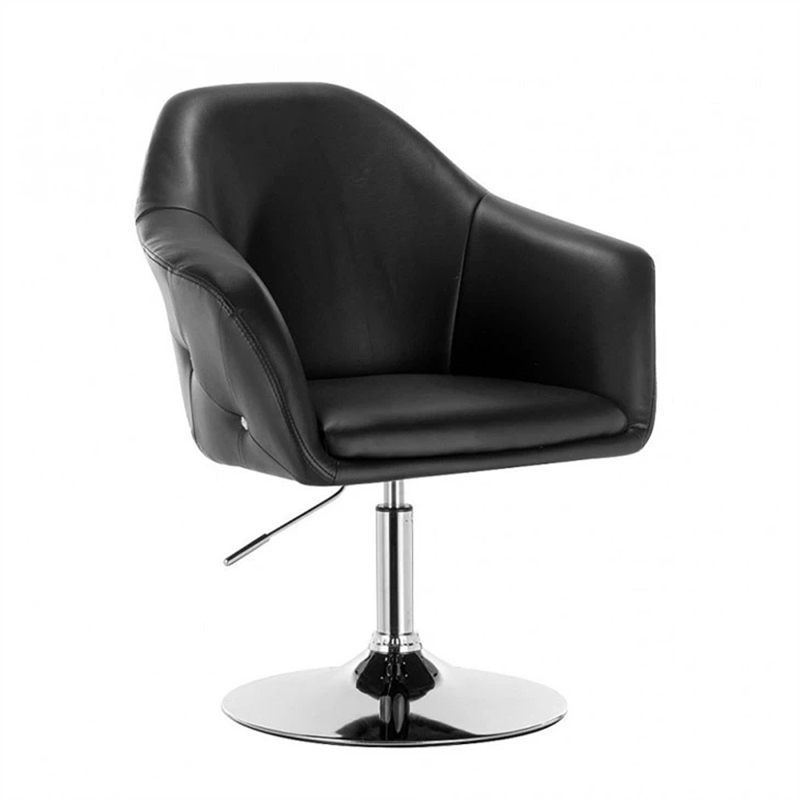 Faux Leather Hydraulic Barber Chair for Commercial SalonsA finished production barber chair with a hydraulic lift, wear-resistant faux leather upholstery and strong stitching. It follows the article's look at pump stroke and base sizing, showing how those specs come together in a real heavy-duty salon model.View Product →
Height Range, Hydraulic Pumps and the Base Footprint
A hydraulic barber chair generally travels from about 19 inches of seat height when lowered to roughly 30 inches when raised, and the pump stroke plus the fixed stack of base and frame decide the exact numbers. Most professional pumps deliver a stroke of 4 to 7 inches. The pump bolts onto a standardized mounting plate, commonly 100 x 100 mm, with 120 x 120 mm and 140 x 140 mm variants reserved for heavier structures. The base itself usually measures 24 to 30 inches across: a wider casting adds weight and steadies the chair through recline, which is why heavy-duty barber models rarely ship with the slim bases fitted to styling chairs.
typical hydraulic pump stroke on professional barber and salon chairs
For salons that want the same lift behavior in a slimmer package:
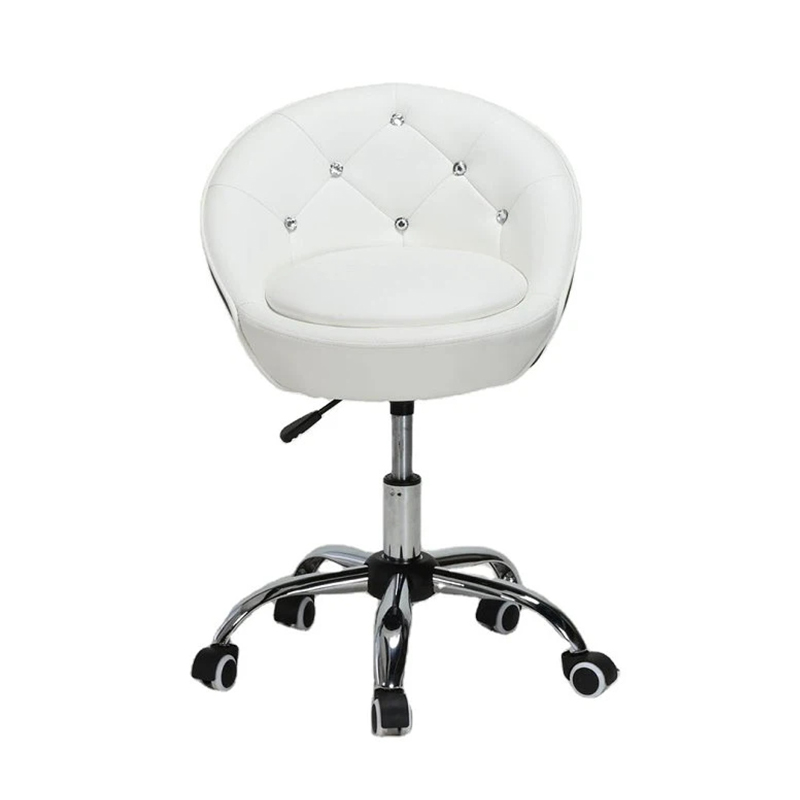 PVC Leather Height Adjustable Barber Salon ChairBuilt on a stable steel frame with hydraulic height adjustment and easy-clean PVC leather, this slimmer chair suits salons wanting the same lift behavior in a lighter package. It fits the discussion of production tolerances and verified lift performance.View Product →
Tolerances: Where the Specification Meets the Production Line
In volume production, key chair dimensions are held to tolerances of about plus or minus 5 mm on frames and seats, and roughly plus or minus 2 degrees on recline angles. Tube-bending jigs, welding fixtures and foam molds hold the geometry; without them a 600 mm seat can drift several millimeters between the first unit and the five hundredth. Quality control then verifies what the fixtures promise: pumps are cycle-tested, frames are static-loaded above their rating, and armrest spread is checked against the drawing before upholstery goes on.
Standard Duty Spec
- Seat width 19-22 in
- Frame tube near 25 mm, 1.2 mm wall
- Pump rated near 300 lb
- Recline about 30 degrees
Heavy Duty Spec
- Seat width 22-26 in
- Frame tube 32-38 mm, 1.5-2.0 mm wall
- Pump rated 450 lb with higher static margin
- Recline to 45 degrees with adjustable headrest
Ask the supplier which figures on the quote are nominal and which are guaranteed. A drawing that states tolerance bands is the difference between furniture that installs smoothly and furniture that needs rework on site.
For multi-service studios that need one platform to cover several tasks:
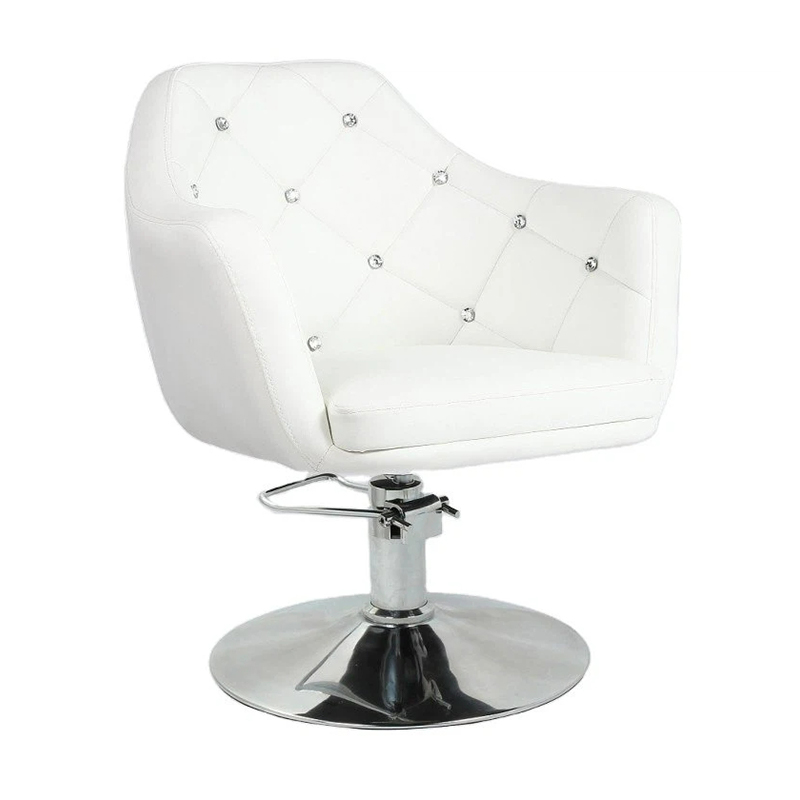 Multipurpose Hydraulic Barber and Nail Salon ChairA compact hydraulic chair with 360° swivel, 18-24 inch height adjustment and a five-point steel base rated to 300 lbs. Serving beauty, nail and barbering tasks in one platform, it matches the article's point on multi-service studios.View Product →
From Floor Plan to Container: Spacing, Packaging and Paperwork
The same dimension sheet that plans the salon floor also decides how many chairs fit in a container, so experienced OEM buyers check both before approving a sample.
Station spacing: work on 36 to 42 inches of width per bay, and reserve a 30 x 48 inch clear floor space at stations where accessibility rules apply.
Recline envelope: a fully reclined chair can reach more than 20 inches behind its base, so keep that zone free of walls and shelving.
Knocked-down packaging: removable legs, bases and armrests cut carton volume sharply, often doubling or tripling the units loaded per 40 ft container compared with assembled shipping.
Documentation: request a dimension drawing with stated tolerances and a packing list with carton sizes before the sample is signed off.
For buyers weighing packaging choices in detail, this guide to KD design and wholesale cost efficiency explains how knocked-down construction changes unit economics across a full order.
Before signing, lay the packed carton dimensions over the assembly sequence. Chairs that ship knocked-down need on-site assembly time, so confirm whether legs, bases and armrests arrive fitted or bagged.
Frequently Asked Questions
What is the standard seat width of a barber chair?
Most professional barber chairs measure 19 to 26 inches inside the armrests, and all-purpose salon models cluster between 21 and 24 inches.
How much space does one barber station need?
Plan 36 to 42 inches of width per station. Many salon planners also allocate 35 to 50 square feet per station once traffic paths, mats and trolleys are included.
What weight capacity should a commercial barber chair have?
A rating between 300 and 450 lb is standard for commercial use, backed by static load tests well above the rated figure. Frame gauge and pump quality decide where a model lands in that band.
Can barber chair dimensions be customized for OEM orders?
Yes. Seat width, armrest spread, foam density, base diameter and pump stroke can all be adjusted at the factory level. Buyers receive dimension drawings with tolerances for approval before mass production begins.
Before any purchase order is signed, mark the base circle, the reclined envelope and the 42-inch bay on the floor plan, then check each number against the supplier's drawing. Ten minutes with a tape measure prevents the most expensive mistake in a salon fit-out.
Related Products
-
 Yangguang Industrial Park 2, Anji County, Huzhou City, Zhejiang Province, China
-
 [email protected]
[email protected]
[email protected]
[email protected]
[email protected]
-
 +86-18357268872
QR CODE

