


 En
 English
 Français
 Español

Saddle Stool Dimensions Explained: Key Specifications for Commercial Applications
Posted by Admin | 28 Oct
Content
- 1 What a Saddle Stool Is and the Five Dimensions That Define It
- 2 Seat Height Range: The Number That Decides Fit
- 3 Seat Width and Depth: Matching the Seat to the Pelvis
- 4 Tilt, Base, and Casters: What Makes a Stool Commercial-Grade
- 5 Turning the Dimensions Into a Supplier-Ready Specification
- 6 Frequently Asked Questions
What a Saddle Stool Is and the Five Dimensions That Define It
A saddle stool is a height-adjustable task seat with a saddle-shaped surface, and its commercial fit comes down to five measurable dimensions: seat height range, seat width, seat depth, tilt angle, and base geometry. Color, stitching, and backrest shape matter for the catalog, but the five numbers decide whether the chair works at the station.
Ranked by their impact on daily comfort, the five dimensions are:
- Seat height range, the travel of the gas lift, which decides who can physically use the chair.
- Seat width and depth, the contact surface that has to match the user's pelvis.
- Tilt angle, meaning whether the seat can slope downward and lock in place.
- Base spread and casters, which control stability and movement across commercial floors.
- Lift class and upholstery grade, which decide how many work cycles the stool survives.
These are build-to-order numbers for most contract factories. Anji Duomei Intelligent Furniture Technology Co., Ltd., a seating manufacturer in Anji County, Zhejiang, China, produces saddle stools for clinics, salons, and spas and accepts OEM and ODM orders, so cylinder travel, seat size, and base finish can be adjusted when you raise them before production. To see how the specifications translate into finished models, browse the full saddle stool range.
Seat Height Range: The Number That Decides Fit
Seat height range is the most consequential line on a saddle stool specification, because it must cover both the body of the user and the height of the work surface at the same time. The working rule: set the seat so the elbow sits level with the work surface and the thighs slope downward 10 to 15 degrees. Staff between roughly 1.65 m and 1.85 m are normally covered by a standard cylinder, while operators who work above patients or at high counters need a tall one.
Massage therapists sit lowest, typically 42 to 56 cm, to work across a treatment table. Estheticians hover around 45 to 60 cm at a facial bed. Stylists and barbers need about 48 to 64 cm behind the chair. Dental work climbs to the top of the scale, which is why clinics usually order a tall cylinder with roughly 50 to 70 cm of travel and a backrest for pause positions between procedures.
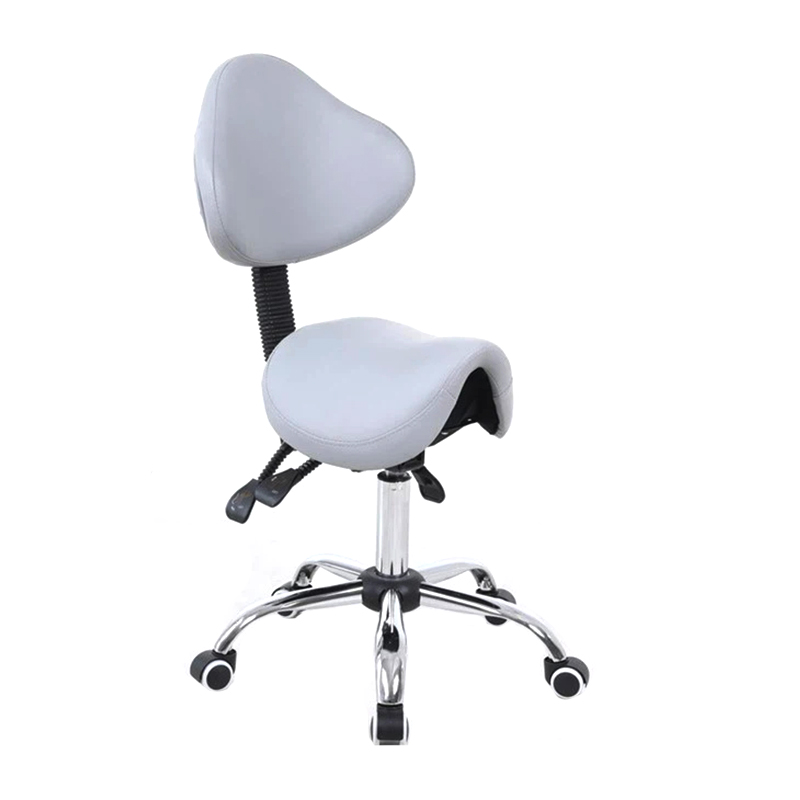 Ergonomic Doctor Saddle Stool With BackrestWith a backrest supporting pause positions between procedures and an adjustable seat height suited to taller clinical work, this saddle stool fits the high travel range dental clinics typically require.View Product →
Seat Width and Depth: Matching the Seat to the Pelvis
Saddle seat width should track the user's pelvic width: wide enough to carry the sit bones, narrow enough to let the thighs slope down without obstruction. Ergonomic guidance for dental professionals is direct on this point, because pelvic width is the measurement that determines the correct size and shape of the seat. Most commercial saddles run 38 to 46 cm wide and 35 to 45 cm deep, with split twin-pad versions for users who find a single saddle too wide.
| Application | Seat width | Seat depth | Seat shape | Tilt range |
| Dental and clinical | 36-42 cm | 34-40 cm | Single or split, raised front | 0 to -12 degrees |
| Salon styling and barbering | 40-46 cm | 36-44 cm | Single saddle, flat rear | 0 to -8 degrees |
| Esthetician and spa | 38-44 cm | 34-40 cm | Single, gentle curve | 0 to -10 degrees |
| Massage therapy | 36-42 cm | 34-38 cm | Narrow single or split | 0 to -12 degrees |
Shape matters as much as the numbers. A raised front edge, common on dental models, stabilizes the pelvis when leaning toward a patient. A flatter rear profile suits stylists who rotate around the chair all day. For mixed teams, plan on at least two seat sizes rather than one model for everyone, which is exactly how multi-chair clinics and salon groups specify their orders.
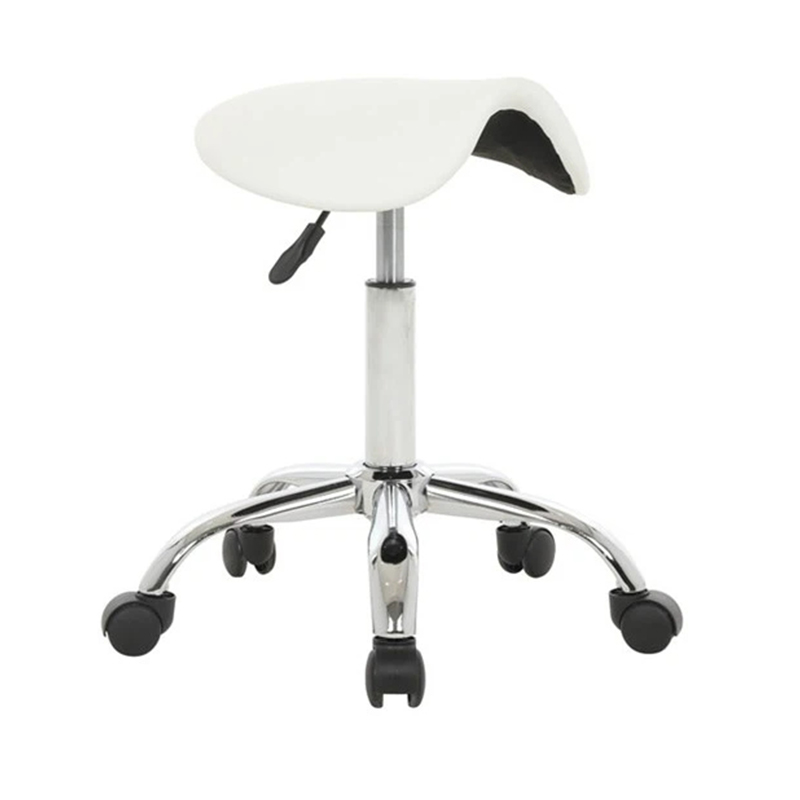 White Saddle Stool Ergonomic Rolling Esthetician SeatA backless, height-adjustable saddle stool on a rolling base, offering the mobility and compact size that suit mixed teams needing varied seat sizes and easy movement between stations.View Product →
Tilt, Base, and Casters: What Makes a Stool Commercial-Grade
Three hardware specs separate a commercial saddle stool from a residential lookalike: a cycle-rated gas lift, a five-star base with enough spread, and casters matched to the floor. Underestimate any of the three and the chair fails long before its upholstery shows wear.
- Gas lift: Class 3 as the minimum, Class 4 for all-day clinics and salons, since lower classes sink and leak under repeated loading.
- Base: a five-star base with a 62 to 70 cm spread resists tipping when the user reaches across a chair, a bed, or a patient.
- Casters: 50 to 75 mm in diameter, with hard treads for tile and soft treads for vinyl, wood, and laminate.
- Tilt: a lockable range of 0 to -15 degrees lets each task set its own seat angle.
Upholstery is the other cycle-driven component. Grade coverings by abrasion rating rather than feel; if the terminology is new, this walkthrough of how Martindale rub counts grade commercial upholstery explains the thresholds used for bar stools, and the same logic carries over to saddle stools. PU and PVC leather stay the default in clinical settings because they wipe clean between patients.
 Ergonomic Swivel Height Salon Saddle Stool With WheelsWith 360-degree swivel, adjustable height, and smooth-rolling casters, this saddle stool suits stylists who rotate around the chair and shares the commercial hardware specs that matter most.View Product →
Turning the Dimensions Into a Supplier-Ready Specification
Write every dimension as a number, not an adjective, and the quotes you receive become comparable. Vague language invites substitution, while measurable limits close it off.
A four-step sequence covers most fit-outs:
- Measure the working surface height at every station, including treatment beds and chair reach zones.
- Record the height range, and where practical the pelvic width, of the staff who will use the stools.
- Fix the numbers: cylinder travel, seat width and depth, tilt lock, base spread, and caster type.
- Trial two or three units on site for two weeks before releasing the full order volume.
Confirm lift class and warranty terms in writing, and ask the supplier to price any dimensional changes before production starts. On OEM and ODM orders, swapping a cylinder or a base finish is a routine request before the line runs; after it runs, it is a new order.
Frequently Asked Questions
These are the specification questions that come up most often before a commercial saddle stool order is placed.
What seat height range does a dental clinic need?
Most clinical work above the patient is comfortable with a tall cylinder covering roughly 50 to 70 cm. Teams with staff under about 1.60 m should verify that the low end still reaches close to 48 cm before ordering.
Is a wider saddle seat always more comfortable?
No. Comfort follows pelvic width, not absolute size. A seat that is too wide prevents the thighs from sloping down and pushes the pelvis into a backward tilt, which is the posture the saddle shape is designed to prevent.
Which casters suit salon and clinic floors?
Use 60 to 75 mm soft-tread wheels on vinyl, wood, and laminate, and hard treads on tile. Larger wheels roll over hair, cables, and thresholds with less resistance, which reduces strain during constant repositioning.
Can saddle stool dimensions be customized for bulk orders?
Yes. Manufacturers working on an OEM and ODM basis, including Anji Duomei, routinely adjust cylinder travel, seat size, base finish, and upholstery to a buyer's specification, provided the changes are agreed before production begins.
Related Products




-
 Yangguang Industrial Park 2, Anji County, Huzhou City, Zhejiang Province, China
-
 [email protected]
[email protected]
[email protected]
[email protected]
[email protected]
-
 +86-18357268872
QR CODE

